lunes, 7 de noviembre de 2022
Revisión de 'Fue en Granada' (Antonio Machado) Por Manuel Suárez Cancela
viernes, 28 de enero de 2011
Kitchen Sink Drama


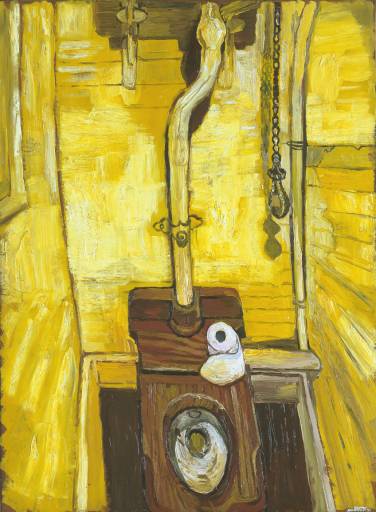
The term "kitchen sink" derived from an expressionist painting by John Bratby, which contained an image of a kitchen sink. The critic David Sylvester wrote an article in 1954 about trends in recent English art, calling his article "The Kitchen Sink" in reference to Bratby's picture. Sylvester argued that there was a new interest among young painters in domestic scenes, with stress on the banality of life. Bratby painted several kitchen subjects, often turning practical utensils such as sieves and spoons into semi-abstract shapes. He also painted bathrooms, and made three paintings of toilets. Other artists associated with the "kitchen sink" style include Derrick Greaves, Edward Middleditch and Jack Smith.
The term was quickly applied to a new style of drama, the hallmark of which was a more realistic representation of social life; country houses and tennis courts were out; ironing boards and minor domestic squalor were in, as in John Osborne's play Look Back in Anger with ironing as a piece of stage business. This was a reaction against the Noel Coward/Terence Rattigan style of dramatic setting.
martes, 11 de enero de 2011
Mini: an Icon of British Culture
The Mini is a small car that was made by the British Motor Corporation (BMC) and its successors from 1959 until 2000. The original is considered a British icon of the 1960s,and its space-saving front-wheel-drive layout (that allowed 80% of the area of the car's floorpan to be used for passengers and luggage) influenced a generation of car-makers.The vehicle is in some ways considered the British equivalent to its German contemporary, the Volkswagen Beetle, which enjoyed similar popularity in North America, or the Spanish Seat 600 which was the best-selling of that age in Spain and Italy. In 1999 the Mini was voted the second most influential car of the 20th Century, behind the Ford Model T, the fist ever created by mass production.This distinctive two-door car was designed for BMC by Sir Alec Issigonis.It was manufactured at the Longbridge and Cowley plants in England, the Victoria Park / Zetland British Motor Corporation (Australia) factory in Sydney, Australia, and later also in Spain (Authi), Belgium, Chile, Italy (Innocenti), Portugal, South Africa, Uruguay, Venezuela and Yugoslavia. The Mini Mark I had three major UK updates: the Mark II, the Clubman and the Mark III. Within these was a series of variations including an estate car, a pickup truck, a van and the Mini Moke—a jeep-like buggy. The Mini Cooper and Cooper "S" were sportier versions that were successful as rally cars, winning the Monte Carlo Rally four times from 1964 through to 1967, although in 1966 the Mini was disqualified after the finish, along with six other British entrants, which included the first four cars to finish, under a questionable ruling that the cars had used an illegal combination of headlamps and spotlights.Initially Minis were marketed under the Austin and Morris names, as the Austin Seven and Morris Mini Minor, until Mini became a marque in its own right in 1969.The Mini was again marketed under the Austin name in the 1980s.
Designed as project ADO15 (Austin Drawing Office project number 15), the Mini came about because of a fuel shortage caused by the 1956 Suez Crisis.Petrol was once again rationed in the UK, sales of large cars slumped, the market for German Bubble cars boomed. Leonard Lord, the somewhat autocratic head of BMC, reportedly detested these cars so much that he vowed to rid the streets of them and design a 'proper miniature car'.He laid down some basic design requirements: the car should be contained within a box that measured 10 × 4 × 4 ft (3 × 1.2 × 1.2 m); and the passenger accommodation should occupy 6 ft (1.8 m) of the 10 ft (3 m) length; and the engine, for reasons of cost, should be an existing unit. Issigonis, who had been working for Alvis, had been recruited back to BMC in 1955 and, with his skills in designing small cars, was a natural for the task. The team that designed the Mini was remarkably small: as well as Issigonis, there was Jack Daniels (who had worked with him on the Morris Minor), Chris Kingham (who had been with him at Alvis), two engineering students and four draughtsmen. Together, by October 1957, they had designed and built the original prototype, which was affectionately named "The Orange Box" because of its colour.
The ADO15 used a conventional BMC A-Series four-cylinder water-cooled engine,but departed from tradition by mounting it transversely, with the engine-oil-lubricated, four-speed transmission in the sump, and by employing front-wheel drive. Almost all small front-wheel-drive cars developed since have used a similar configuration, except with the transmission usually separately enclosed rather than using the engine oil. The radiator was mounted at the left side of the car so that the engine-mounted fan could be retained, but with reversed pitch so that it blew air into the natural low pressure area under the front wing. This location saved precious vehicle length, but had the disadvantage of feeding the radiator with air that had been heated by passing over the engine. It also exposed the entire ignition system to the direct ingress of rainwater through the grille.
The suspension system, designed by Issigonis's friend Dr. Alex Moulton at Moulton Developments Limited, used compact rubber cones instead of conventional springs. This ingenious space-saving design also featured rising progressive-rate springing of the cones, and provided some natural damping. Built into the subframes, the rubber cone system gave a raw and bumpy ride which was accentuated by the woven-webbing seats, but the rigidity of the rubber cones, together with the wheels being pushed out to the corners of the car, gave the Mini go kart-like handling that would become famous.
Initially an interconnected fluid system was planned—similar to the one that Alec Issigonis and Alex Moulton were working on in the mid-1950s at Alvis. They had assessed the mechanically interconnected Citroen 2CV suspension at that time (according to an interview by Moulton with CAR magazine in the late 1990s), which inspired the design of the Hydrolastic suspension system for the Mini and Morris/Austin 1100, to try to keep the benefits of the 2CV system (ride comfort, body levelling, keeping the roadwheel under good control and the tyre in contact with the road), but with added roll stiffness that the 2CV was very much lacking. The short development time of the car meant this was not ready in time for the Mini's launch. The system intended for the Mini was further developed and the hydrolastic system was first used on the Morris 1100, launched in 1962; the Mini gained the system later in 1964. Ten-inch (254 mm) wheels were specified, so new tyres had to be developed, the initial contract going to Dunlop. Issigonis went to Dunlop stating that he wanted even smaller, 8 in (203 mm) wheels (even though he had already settled on ten-inch). An agreement was made on the ten-inch size, after Dunlop choked on the eight-inch proposition.
Sliding windows allowed storage pockets in the hollow doors; reportedly Issigonis sized them to fit a bottle of Gordon's Gin. The boot lid was hinged at the bottom so that the car could be driven with it open to increase luggage space. On early cars the number plate was hinged at the top so that it could swing down to remain visible when the boot lid was open. This feature was later discontinued after it was discovered that exhaust gases could leak into the cockpit when the boot was open.
The Mini was designed as a monocoque shell with welded seams visible on the outside of the car running down the A and C pillars, and between the body and the floor pan. To further simplify construction, the hinges for the doors and boot lid were mounted externally.
Cross-section shows how Mini maximizes passenger space
Production models differed from the prototypes by the addition of front and rear subframes to the unibody to take the suspension loads, and by having the engine mounted the other way round, with the carburettor at the back rather than at the front. This layout required an extra gear between engine and transmission to reverse the direction of rotation at the input to the transmission. Having the carburettor behind the engine reduced carburettor icing, but the distributor was then exposed to water coming in through the grille. The engine size was reduced from 948 cc to 848 cc; this, in conjunction with a small increase in the car's width, cut the top speed from 90 mph (145 km/h) to a more reasonable (for the time) 72 mph (116 km/h).
Despite its utilitarian origins, the classic Mini shape had become so well known that by the 1990s, Rover Group—the heirs to BMC—were able to register its design as a trade mark in its own right.
martes, 4 de enero de 2011
The New Year's London Parade

Ever wondered how one of the World’s great turn of year traditions came about?
The New Year’s Day Parade – London has evolved in to one of the World’s great street spectaculars with up to 10,000 performers from across continents, hundreds of thousands of spectators on the streets – and a live television audience of tens of millions.
But way back in the 20th Century in the event’s formative years – the parade was a relatively humble affair.
The first "Lord Mayor of Westminster's Big Parade", as it was then known, took place on 1st January 1987 and even though a lot smaller than today London had never seen anything quite like it.
It provided a feast of free entertainment for all the family on what had probably become the dreariest day of the year. Featuring hundreds of dancers and musicians from home and abroad, it put real American style razzmatazz onto the streets of London. It received such an overwhelming ‘thumbs up’ from Londoners, tourists and indeed also from the authorities, that it looked like it was here to stay.
Nearly 25 years on, the New Year’s Day Parade London is the biggest event of its kind in the world, boasts a street-side audience approaching 1/2 a million, receives a huge amount of international media coverage, has a list of Patrons that represent the very highest levels of officialdom, and also enjoys the recognition and support of Her Majesty Queen Elizabeth II. Put simply, the event has grown from something that started big to something that is now colossal.
miércoles, 29 de diciembre de 2010
Boxing Day
In Britain, Boxing Day is usually celebrated on the following day after Christmas Day, which is 26th of December. However, strictly speaking, Boxing Day is the first weekday after Christmas (see definition in the Oxford English Dictionary).
Like Christmas Day, Boxing Day is a public holiday. This means it is typically a non working day in the whole of Britain. When Boxing Day falls on a Saturday or Sunday the following Monday is the public holiday.
Why is 26 December called Boxing Day?
Traditionally, 26 December was the day to open the Christmas Box to share the contents with the poor. And what is a Christmas Box? The Christmas box was a wooden or clay container where people placed gifts.
Boxing Day origins; Christmas Boxes were used in different ways:
-To protect ships: Exploration ship during the Age of Exploration, when great sailing ships were setting off to discover new land, A Christmas Box was used as a good luck device. It was a small container placed on each ship while it was still in port. It was put there by a priest, and those crewmen who wanted to ensure a safe return would drop money into the box. It was then sealed up and kept on board for the entire voyage. If the ship came home safely, the box was handed over to the priest in the exchange for the saying of a Mass of thanks for the success of the voyage. The Priest would keep the box sealed until Christmas when he would open it to share the contents with the poor.
-Church To help the poor: An 'Alms Box' was placed in every church on Christmas Day, into which worshippers placed a gift for the poor of the parish. These boxes were always opened the day after Christmas, which is why that day became know as Boxing Day.
-A present for the workers: Many poorly paid workers were required to work on Christmas Day and took the following day off to visit their families. As they prepared to leave, their employers would present them with Christmas boxes.
During the late 18th century, Lords and Ladies of the manor would "box up" their leftover food, or sometimes gifts and distribute them the day after Christmas to tenants who lived and worked on their lands.
And the tradition still continues today ......
The tradition of giving money to workers still continues today. It is customary for householders to give small gifts or monetary tips to regular visiting trades people (the milkman, dustman, coalman, paper boy etc.) and, in some work places, for employers to give a Christmas bonus to employees.
Schools across the country gather together gifts to be put in Christmas Boxes that are sent to poorer countries.
miércoles, 22 de diciembre de 2010
Trafalgar Square Christmas Tree

The Trafalgar Square Christmas tree has been a seasonal symbol in London since 1947. It takes pride of place in the square until January, when it is taken down for recycling. The tree is decorated in traditional Norwegian fashion, using vertical strings of energy-efficient bulbs. Carols are performed beside the tree by a wide variety of London groups each evening from December 7 to 22, 5-9pm. The tree is a gift from the Norwegians to the British and there's a remarkable story behind this traditional present-giving. During World War II, German troops besieged Norway and in 1940 the neutral country was forced to surrender to the Nazis. Its royal family, government and defence chiefs fled to London, where they established a government-in-exile. For almost five years they were given refuge here while Norwegian soldiers fought alongside the Allies. London came to represent hope and freedom for the millions in occupied Norway, who listened to British radio broadcasts which provided news and information vital to the resistance movement. That's why the people of Oslo now give London the tree. Fondly described by the woodsmen who care for it as 'the queen of the forest', it can reach up to 25m in height and is between 50 and 100 years old. It's felled in November in a special ceremony in the midst of a snowy forest, with local schoolchildren singing. Once it's been shipped across the North Sea and installed, its official illumination takes place in early December.
martes, 23 de noviembre de 2010
English Afternoon Tea

Afternoon tea (because it was usually taken in the late afternoon) is also called "low tea" because it was usually taken in a sitting room or withdrawing room where low tables (like a coffee table) were placed near sofas or chairs generally in a large withdrawing room. There are three basic types of Afternoon, or Low Tea:
Cream Tea - Tea, scones, jam and cream
Light Tea - Tea, scones and sweets
Full Tea - Tea, savories, scones, sweets and dessert
In England, the traditional time for tea was four or five o'clock and no one stayed after seven o'clock. Most tea rooms today serve tea from three to five o'clock. The menu has also changed from tea, bread, butter and cakes, to include three particular courses served specifically in this order:
Savories - Tiny sandwiches or appetizers
Scones - Served with jam and Devonshire or clotted cream
Pastries - Cakes, cookies, shortbread and sweets.
Prior to the introduction of tea into Britain, the English had two main meals, breakfast and dinner. Breakfast was ale, bread, and beef. During the middle of the eighteenth century, dinner for the upper and middle classes had shifted from noontime to an evening meal that was served at a fashionable late hour. Dinner was a long, massive meal at the end of the day.
Tea Etiquette
In order for one not to spill the hot liquid onto oneself, the proper way to hold the vessel of a cup with no handle is to place one’s thumb at the six o'clock position and one’s index and middle fingers at the twelve o'clock position, while gently raising one’s pinkie up for balance.
Tea cups with a handle are held by placing one’s fingers to the front and back of the handle with one’s pinkie up again allows balance. Pinkie up does mean straight up in the air, but slightly tilted. It is not an affectation, but a graceful way to avoid spills. Never loop your fingers through the handle, nor grasp the vessel bowl with the palm of your hand.
Do not stir your tea, with your tea spoon, in sweeping circular motions. Place your tea spoon at the six o'clock position and softly fold the liquid towards the twelve o'clock position two or three times. Never leave your tea spoon in your tea cup. When not in use, place your tea spoon on the right side of the tea saucer. Never wave or hold your tea cup in the air. When not in use, place the tea cup back in the tea saucer. If you are at a buffet tea hold the tea saucer in your lap with your left hand and hold the tea cup in your right hand. When not in use, place the tea cup back in the tea saucer and hold in your lap. The only time a saucer is raised together with the teacup is when one is at a standing reception.
Milk is served with tea, not cream. Cream is too heavy and masks the taste of the tea. Although some pour their milk in the cup first, it is probably better to pour the milk in the tea after it is in the cup in order to get the correct amount.
When serving lemon with tea, lemon slices are preferable, not wedges. Either provide a small fork or lemon fork for your guests, or have the tea server can neatly place a slice in the tea cup after the tea has been poured. Be sure never to add lemon with milk since the lemon's citric acid will cause the proteins in the milk to curdle.
jueves, 18 de noviembre de 2010
14th November --- Lord Mayor's

The Lord Mayors Show London celebrates an 800 year London tradition in grand, historic style. Take to the streets on Saturday 13th November to enjoy parades, festivities, fireworks and more in a truly historic London event.
Historic event
The fireworks spectacle and parade first took place in 1215, during which the Lord Mayor was presented to the Sovereign for approval. The procession's traditional journey from the City to Westminster has over the years grown in size and the event now includes a full parade and show, in which officials, workers and Londoners of all ages and all walks of life come together to celebrate London’s heritage.
Around 6,000 people will be involved in the event alongside carriages, marching bands, floats and other vehicles. The procession itself is around three miles long, and promises to be a memorable sight as it makes its way from The City to St Paul’s Cathedral. Starting out from Mansion House the beginning of the procession will be marked by aircraft fly-past.
Pomp and circumstance
The Lord Mayors Show London is a traditional affair combining eight centuries of London history. The first event to ever be broadcast live on TV, it has survived the Black Death and The Blitz and this year’s event is expected to attract 500,000 people to the capital's streets whilst millions more watch the event at home on TV.
Lord Mayors Show London 2010
Londoners of all ages can join in the fun at a landmark London event which is guaranteed to be something special for 2010. Expect plenty to see and do throughout the show, with 2,000 servicemen and women taking part in the processions alongside 220 vehicles, 71 floats, 13 marching bands and 21 carriages, including the lavish State Coach.
Showstopping fireworks
It is traditional for the Lord Mayors Show London event to finish spectacularly with a gigantic fireworks display launched from a barge on the River Thames, located between Waterloo Bridge and Blackfriars Bridge. The fireworks display marks the end of the show and the beginning of a new mayoral year and it is widely expected to be one of the most stunning fireworks displays of 2010. Crowds of Londoners will head to the river to watch the fireworks which start at 5pm.
The Lord Mayors Show London takes place on Saturday 13th November 2010, with the procession beginning at 11am. Arrive early anywhere along the route to ensure a good spot. The event is free to attend. Fireworks are due to begin at 5pm.
martes, 16 de noviembre de 2010
Why Big Ben?

Today, if you ask someone about what image comes to his/her mind when you pronounce the word `London´ automatically 99 per cent will say Big Ben.
The title Big Ben is commonly used for the clock-tower placed at the north-west corner of the Houses of Parliament, but that is a bit inexact because the name belongs solely to the big bell inside the tower.
Two possibilities are taken into account about the name `Ben´. Some say it's in its first builder honour, Mr.Benjamin Hall. Others claim that was in Ben Caunt's honour, a very famous boxer at that time.
The present tower was raised as a part of Charles Barry's design for a new palace, after the old Palace of Westminster was destroyed by fire on the night of 16 October 1834. The new Parliament was built in a Neo-gothic style. Although Barry was the chief architect of the Palace, he turned to Augustus Pugin for the design of the clock tower, which resembles earlier Pugin designs, including one for Scarisbrick Hall. The design for the Clock Tower was Pugin's last design before his final descent into madness and death, and Pugin himself wrote, at the time of Barry's last visit to him to collect the drawings: "I never worked so hard in my life for Mr Barry for tomorrow I render all the designs for finishing his bell tower & it is beautiful." The tower is designed in Pugin's celebrated Gothic Revival style, and is 96.3 metres high.
There are six shields above each of the four clock faces, twenty-four in total, all depicting the arms of St George, representing the Flag of England, London as the Capital City of England, and St. George as the Patron Saint of England. This symbolism is also repeated in the Central Lobby of the Houses of Parliament, directly opposite the House of Commons, in an enormous mosaic created by Sir Edward John Poynter in 1869, depicting St George and the Dragon with these arms, entitled “St George for England.”
The bottom 61 metres of the Clock Tower's structure consists of brickwork with sand coloured Anston limestone cladding. The remainder of the tower's height is a framed spire of cast iron. The tower is founded on a 15-metre square raft, made of 3-metre thick concrete, at a depth of 4 metres below ground level. The four clock dials are 55 metres above ground. The interior volume of the tower is 4,650 cubic metres.
Despite being one of the world's most famous tourist attractions, the interior of the tower is not open to overseas visitors, though United Kingdom residents are able to arrange tours (well in advance) through their Member of Parliament.However, the tower has no elevator, so those escorted must climb the 334 limestone stairs to the top.
Because of changes in ground conditions since construction (notably tunnelling for the Jubilee Line extension), the tower leans slightly to the north-west, by roughly 220 millimetres at the clock dials, giving an inclination of approximately 1/250. Due to thermal effects it oscillates annually by a few millimetres east and west.
martes, 9 de noviembre de 2010
Tasty Cuisine? Curry...

Contrary to popular belief, the modern British now consume more garlic per head than the French or the Spaniards, in spite of the fact that Vicky Beckham says ``Spain smells like garlic´´.
Joking apart, at least in my opinion it's quite clear than British cuisine has been unfairly vilified, and it is absolutely clear that has absorbed the cultural influence of those that have settled in the UK, producing a very rich wide range of hybrid dishes from very different origins.
Probably the most notorious influence comes from India, so I would like to write an Indian recipe that a friend of mine (from London) gave me years ago when I was in London, and I prepare it now and then. It has nothing, it's really easy and tastes nice.
Curried Rice with Prawns:
* Time: 25 min
* Difficulty: minimum (even I can do it myself)
* nº people: 4
Ingredients:
- a bit of butter/ or olive oil
- 500 g rice
- 1/2 L of stock
- 2 little onions
- 1 tea spoon of curry powder
- 300 g of frozen prawns
- 2 golden apples
- 250 ml liquid cream
- salt
How to prepare it:
Chop the little onions up and fry them lightly; peel the apples and cut them into little cubes about one centimetre. After that, add them to the lightly fried onions, let it cook two minutes and add the tea spoon of curry powder. Put the stock in the pan and when the mixture strats boiling and the rice, the prawns and salt at taste (not too much, you can always adjust the seasonig if necessary). If you fancy can add some peas, they fit well in this dish. Let it boil for four minutes and then add the cream.
Finishing: After the cream let it boiling some minutes, try the salt again, and put a bit of chopped parsley. It's OK, serve in soup dishes.
Tea Party?

Nowadays we relate the words ``Tea Party´´ with the ultra-conservative right wing of the Republican party in the US. But, What's that? Why that name?
As many of you probably now, the Tea party was a revolutionary movement in the pre-American Revolution against the British Tea act wich had been passed by the British Parliament in 1773.
The Boston Tea Party was a direct action by colonists in Boston, a town in the British colony of Massachusetts, against the British government and the monopolistic East India Company that controlled all the tea coming into the colonies. On December 16, 1773, after officials in Boston refused to return three shiploads of taxed tea to Britain, a group of colonists boarded the ships and destroyed the tea by throwing it into Boston Harbor. The incident remains an iconic event of American history, and other political protests often refer to it.
The Boston Tea Party arose from two issues confronting the British Empire in 1773: the financial problems of the British East India Company, and an ongoing dispute about the extent of Parliament's authority, if any, over the British American colonies without seating any elected representation. The North ministry's attempt to resolve these issues produced a showdown that would eventually result in revolution.
viernes, 29 de octubre de 2010
Pet Shop Boys

When I hear a Pet Shop Boys song automatically I travel to my teen age times because I was a real fun by then. Time's gone by but I keep thinking they are probably the best dance techno music band of all times (maybe I should make a mention for Depeche Mode).
All of you probably know them well, but if you don't I strongly recomend you to buy, download, so on..., take your music sistem and have a good time with their songs; here you have some information about:
Pet Shop Boys are an English electronic dance music duo, consisting of Neil Tennant, who provides main vocals, keyboards and occasional guitar, and Chris Lowe on keyboards.
They are one of the world's best-selling music artists, Pet Shop Boys have sold over 100 million records worldwide,and are listed as the most successful duo in UK music history by The Guinness Book of Records.Three-time BRIT Award winners and six-time Grammy nominees, since 1986 they have achieved 42 Top 30 singles and 22 Top 10 hits in the UK Singles Chart, including four Number Ones: "West End Girls", "It's a Sin", "Always on My Mind" and "Heart".
At the 2009 BRIT Awards, Pet Shop Boys received an award for Outstanding Contribution to Music. The duo's latest studio album, Yes (continuing their tradition of single word titles) was released on 23 March 2009.[3] It was followed with the live CD and DVD Pandemonium released 15 February 2010, filmed and recorded live at the London O2 Arena in December 2009.
jueves, 28 de octubre de 2010
Halloween

Halloween (or Hallowe'en) is an annual holiday observed on October 31, primarily in the United States, Canada, Ireland, and the United Kingdom. It has roots in the Celtic festival of Samhain and the Christian holiday All Saints' Day, but is today largely a secular celebration.
Common Halloween activities include trick-or-treating, wearing costumes and attending costume parties, carving jack-o'-lanterns, ghost tours, bonfires, apple bobbing, visiting haunted attractions, committing pranks, telling ghost stories or other frightening tales, and watching horror films.
The ancient Celts believed that the border between this world and the Otherworld became thin on Samhain, allowing spirits (both harmless and harmful) to pass through. The family's ancestors were honoured and invited home while harmful spirits were warded off. It is believed that the need to ward off harmful spirits led to the wearing of costumes and masks. Their purpose was to disguise oneself as a harmful spirit and thus avoid harm. In Scotland the spirits were impersonated by young men dressed in white with masked, veiled or blackened faces. Samhain was also a time to take stock of food supplies and slaughter livestock for winter stores. Bonfires played a large part in the festivities. All other fires were doused and each home lit their hearth from the bonfire. The bones of slaughtered livestock were cast into its flames.Sometimes two bonfires would be built side-by-side, and people and their livestock would walk between them as a cleansing ritual.
Another common practice was divination, which often involved the use of food and drink.
The name 'Halloween' and many of its present-day traditions derive from the Old English era.
martes, 19 de octubre de 2010
The Continent won't be isolated any more

The Channel Tunnel (French: Le tunnel sous la Manche), (also informally known as the Chunnel) is a 50.5-kilometre (31.4 mi) undersea rail tunnel linking Folkestone, Kent near Dover in the United Kingdom with Coquelles, Pas-de-Calais near Calais in northern France beneath the English Channel at the Strait of Dover. At its lowest point, it is 75 metres (250 ft) deep.At 37.9 kilometres (23.5 mi), the Channel Tunnel possesses the longest undersea portion of any tunnel in the world.
The tunnel carries high-speed Eurostar passenger trains, Eurotunnel Shuttle roll-on/roll-off vehicle transport—the largest in the world—and international rail freight trains. The tunnel connects end-to-end with the LGV Nord and High Speed 1 high-speed railway lines. In 1996 the American Society of Civil Engineers identified the tunnel as one of the Seven Wonders of the Modern World.
Ideas for a cross-Channel fixed link appeared as early as 1802, but British political and press pressure over compromised national security stalled attempts to construct a tunnel. However, the eventual successful project, organised by Eurotunnel, began construction in 1988 and opened in 1994. The project came in 80% over its predicted budget.Since its construction, the tunnel has faced several problems. Fires have disrupted operation of the tunnel. Illegal immigrants and asylum seekers have attempted to use the tunnel to enter Britain, causing a minor diplomatic disagreement over the siting of the Sangatte refugee camp, which was eventually closed in 2002.
Total cross-tunnel passenger traffic volumes peaked at 18.4 million in 1998, then dropped to 14.9 million in 2003, from then rising again to 16.1 million in 2008.
At the time of deciding to build the tunnel, 15.9 million passengers were predicted for Eurostar trains in the opening year. In 1995, the first full year, actual numbers were a little over 2.9 million, growing to 7.1 million in 2000, then dropping again to 6.3 million in 2003. However, Eurostar was also limited by the lack of a high-speed connection on the British side. After the completion of High Speed 1 (formerly CTRL) to London in two stages in 2003 and 2007, traffic increased. In 2008, Eurostar carried 9,113,371 passengers in cross-Channel-Tunnel traffic, a 10% increase over the previous year, despite traffic limitations due to the 2008 Channel Tunnel fire.
sábado, 9 de octubre de 2010
COUNTY OF YORKSHIRE
Yorkshire is a historic county of northern England and the largest in the United Kingdom.Because of its great size in comparison to other English counties, functions have been increasingly undertaken over time by its subdivisions, which have also been subject to periodic reform. Throughout these changes, Yorkshire has continued to be recognised as a geographical territory and cultural region.The name is familiar and well understood across the United Kingdom and is in common use in the media and the military,and also features in the titles of current areas of civil administration, such as Yorkshire and the Humber and West Yorkshire.
Within the borders of the historic county of Yorkshire are areas which are widely considered to be among the greenest in England, due to the vast stretches of unspoiled countryside in the Yorkshire Dales and North York Moors and to the open aspect of some of the major cities.Yorkshire has sometimes been nicknamed God's Own County.The emblem of Yorkshire is the white rose of the English royal House of York, and the most commonly used flag representative of Yorkshire is the White Rose on a dark blue background,which after years of use, was recognised by the Flag Institute on 29 July 2008.Yorkshire Day, held on 1 August, is a celebration of the general culture of Yorkshire, ranging from its history to its own language.
martes, 21 de septiembre de 2010
Spanish Armada (1588) La Armada Invencible

The Spanish Armada (Spanish: Grande y Felicísima Armada, "Great and Most Fortunate Navy") was the Spanish fleet that sailed against England under the command of the Duke of Medina Sidonia in 1588, with the intention of overthrowing Elizabeth I of England to stop English involvement in the Spanish Netherlands and English-sponsored piracy in the Atlantic. The fleet's mission was to sail to the Gravelines in Flanders and transport the famous Tercios de Flandes, a ground force of over 30,000 men led by the Duke of Parma, across the Channel to England. The mission eventually failed due to strategic errors of the Spanish Commander, the Duke of Medina Sidonia, bad weather, and early English attacks on the Armada, especially during the Battle of Gravelines.
The failed mission was an early event in a nearly twenty year long Anglo-Spanish war.
The expedition of the Spanish Armada led to a similar campaign by England the following year, the failed Drake–Norris Expedition of 1589,sent to occupy Portugal and northwestern Spain, which was also unsuccessful.
miércoles, 1 de septiembre de 2010
St George's Cross

St George's Cross (or the Cross of St George) is a red cross on a white background used as a symbolic reference to Saint George. The red cross on white was associated with St George from medieval times.
St George's Cross has been adopted on the coat of arms and flags of several countries and cities which have St George as a patron saint, notably England, Georgia, Aragon, Greece, Genoa and Barcelona.
The cross is also found, for various reasons, on the provincial flag of Huesca, Zaragoza and Teruel as well as the municipal flag for numerous cities, including Montreal, Almería, Milan, Genoa, Padua, Zadar and Freiburg im Breisgau. It is also the basis for the Four Moors flag of Sardinia. Guernsey was permitted to use it as its state flag between 1936 and 1985.
Historically, the cross appeared on many now extinct flags, emblems and coats of arms, such as that of the Swabian League in late Medieval Germany.
Like other countries with St George as a patron, the English frequently used St George's cross as their symbol.
During the first Crusade, the Pope decided that knights of different nationalites should be distinguished by different colours of cross. French knights were allocated the red cross on white. English knights complained about this, since they considered this to be "their" St George's cross.
In 1188 the French King, Philip II of France accepted the claim of the English to the red cross on white, and the English and French officially exchanged their respective crosses. However by this time, the red cross on white had become a typical crusader symbol.
From about 1277, due to already widespread use, St George's cross officially became the national flag of England and Wales. The three lions remained the coat of arms and flag of the king.
After the dynastic union of England and Scotland in 1603 (the so-called "Union of the Crowns"), a combined British flag was created in 1606, initially for maritime display, later restricted to the King's ships, by combining St George's Cross with the St Andrew's Cross (the flag of Scotland). The St George flag remained the flag of England and Wales for other purposes until the Acts of Union 1707. At the union, the first Union Flag become official for all purposes in the new Kingdom of Great Britain.
Nevertheless, in heraldry the St George's Cross continued to be used in the fly of standards in English and Welsh grants of arms (until a gradual change in practice in the nineteenth century). It is still used to represent England and by those who wish to show pride in England specifically. Nowadays this is primarily done at events such as international football and rugby union competitions. (Since the adoption of a separate Welsh flag in 1959, the St George's Cross has become associated with England alone, rather than England and Wales.)
The flag of St George is also the rank flag of an Admiral in the Royal Navy, and civilian craft are forbidden to fly it. However, ships which took part in the rescue operation at Dunkirk during World War II are allowed to fly it as a jack.
Churches belonging to the Church of England (unless for special reasons another flag is flown by custom) may fly the St George's Cross. The correct way (since an order from the Earl Marshal in 1938) is for the church to fly the St George's cross, with the arms of the diocese in the left-hand upper corner of the flag.
The flag of St George has since the late 20th century enjoyed a resurgence in popularity partly due to football-inspired nationalism, and also in response to the devolution movements in Scotland and Wales.
viernes, 21 de mayo de 2010
Sensory Experiment
Nowadays chefs go to great lengths to be more creative and traditional concepts are fast changing in the world of cooking.
There are many chefs we could name but one place has a different approach and even wants us to test our senses. This is the Fat Duck! They have an interesting ways, for anyone who is adventurous,to have a go for themselves....what will you perceive??
The only answer to that is test your our senses...how good are they....what will you learn from this experience? Is it what you expected? Did you capture the essence of the experiment? Will it affect how you perceive food from now on?
Why don´t you have a go and don´t forget to take a good look at the whole website..you´ll enjoy it.
http://www.thefatduck.co.uk/About-The-Fat-Duck/
Have a nice weekend! ^_^
martes, 4 de mayo de 2010
RECYCLING

'Waste not want not'
This is an old English says which refers to not wasting resources, the proof of the pudding is that nowadays most parts of the world try to recycle waste products like paper; plastic; cardboard;styrofoam; aluminium cans, steel cans, waste metals, glass bottles and jars; used oils; paint and biodegradable waste products from the kitchen and garden.
These are just a few things that we can all make a personal effort in keep our planet clean...you might say to yourself...'What I do won´t make a difference' but if we all said that we´d be buried under our own rubbish! The thing is we all love to walk down a clean street, we love going to parks with our families, we even travel to far of places to relax and enjoy but imagine all of these places covered in our household rubbish...!
We all have the responsibility to keep our planet clean not only for ourselves but for future generations.
So the question is a personal one.... What do I do to waste less and to recycle more?
jueves, 29 de abril de 2010
WILLIAM SHAKESPEARE

William Shakespeare was baptized 26 April 1564 died 23 April 1616
Who was William Shakespeare?
William Shakespeare was an English poet and playwright.
Why is William Shakespeare famous? Because Shakespeare is widely regarded as the greatest writer in the English language. A lot of what he wrote is still read and performed today you only have to go to the Globe Theatre near the Millenium Bridge and the Tate Modern to see some of his work performed live. He wrote 38 plays, 154 sonnets, two long narrative poems, and several other poems.
Shakespeares Life
Shakespeare was born and raised in Stratford-upon-Avon, England. At the age of 18, he married Anne Hathaway and together they had three children: Susanna, and twins Hamnet and Judith. They lived in a beautiful house situated in the village of Shottery, Warwickshire, England, and about 1 mile (1.6 km) west of Stratford-upon-Avon. Although it is often called a cottage, it is, in fact, a spacious twelve-roomed farmhous. The visible timber framing, a trademark of vernacular Tudor style architecture
1585 -1592, Shakespeare worked in London as an actor, writer, and part owner of a playing company called the Lord Chamberlain's Men, later known as the King's Men.
His famous works are:
A Midsummer Night's Dream
Macbeth
Twelfth Night
Hamlet
Romeo and Juliet
Julius Caesar
For more information use the official website: http://www.shakespeare.org.uk/